Wednesday, March 7, 2012

Kivalamo – the Road Less Traveled – For a Good Reason


It was a nail-biter, that’s for sure!  If you read about our adventures on our trip home from Ugesa a couple of weeks ago, well, our trip home from Kivalamo trumps that. 

When plans were being made to go to Kivalamo during the rainy season, we were very well aware that the road could be impassable at times, so we made many inquiries about road conditions. The last report we received was from two days ago when we were told the road was “good” – a relative term, to be sure.  You may recall from yesterday’s blog that heavy rains were forecasted for the region, and we had some rain during the night, but we were optimistic and left for Kivalamo at 7:00, hoping to be there by 10:00.

The first leg of our trip was fine; we didn’t see any signs of the overnight rain.   After passing through Kidabaga we started seeing water standing on the sides of the roads.  When we reached a fork in the road where we had to decide whether to take the shorter, more direct route to Kivalamo, or the longer road through Idete we chose the shorter route.  After going only a couple hundred meters we found we were sliding downhill while attempting to drive uphill, Tom backed up and took the other road.  This alternate route was a challenge to Tom’s driving skills, with deep gullies and wash outs every few meters, and tall grass growing down the middle of the road.

As we approached Kivalamo, pedestrians told us that a truck was blocking the road.  We felt we had no choice at that point but to continue, so we did.  About three kilometers from Kivalamo we came upon the stalled truck.  We discovered it was completely blocking the road.  Tom parked the car on the side of the road (the side, in this case, was tall grass and shrubs) and we walked the remainder of the way - fifty minutes up and down the hills and through the mud!

We were met by Pastor Faus Duma and since we were concerned about getting home before dark, especially with a 50 minute walk ahead of us before we reached our car, we decided to forego the usual tea with the pastor and start our meeting right away.

Kivalamo had tried to start a SACCOS several years ago.  At that time they had elected leaders, collected fees, and started collecting savings.  They tried to open a bank account – but found they couldn’t it without a registration number, and for that they needed a constitution and officers.  At that point they realized they did not know what to do or how to proceed and so they gave up.  When they learned that there was a Micro Finance Institute that could help them, they were once again interested in getting started.  Today we met with 24 interested persons (11 men and 13 women) from the original group.

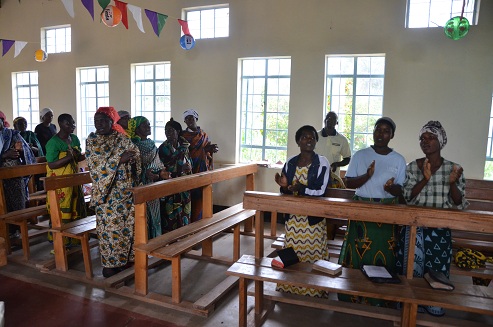
We started off with prayers and singing (not all of the members are Lutherans – still they joined right in).  After opening comments Enock started his class.  When he finished there were many questions that were answered by Enock– a good session!  When we went to have lunch at the pastor’s house they elected new leaders and made sure that we would have room for them at our training session. 

We were all impressed by the eagerness of this group.  The members told us over and over how they have wanted to have a SACCOS for a long time – but didn’t know how to go about it.  Members we interviewed told us that they needed a SACCOS to help them save and get capital.  Once again we heard that they could not apply the CVP lessons to their fields since they did not have and could not get the capital they needed.  Some were hoping to raise livestock.  Everyone seemed to understand that a SACCOS meant saving as well as getting loans – and were excited about being able to do both!

As were finishing our lunch we heard a very light rain falling on the roof.  Looking across the valley we saw heavy rain approaching.  We waited until it passed and started our walk back to the vehicle.  We were fortunate to have no rain fall on us while we were walking.  Tom had to execute a u-turn on the very narrow road, with one side backing up to the mountain and the other side dropping straight down.  That done we were on our way.  The afternoon downpour had turned the roads into slippery goo which made the challenging gullies and wash-outs from this morning nearly impassable.  We slid down many of the mountain roads as Tom did his best to steer us around the bends.  After 30 minutes of white knuckles and clenched teeth the road-bed improved slightly, but we didn’t really relax until we got back to Kidabaga. Mr. Toad’s wild ride couldn’t have been crazier. 

Pastor Duma met us in Kidabaga for a ride to Iringa.  He had arranged to ride his motorcycle as far as Kidabaga, where he would park it and then ride with us the rest of the way.  He took the shorter route down the mountain and almost didn’t make it.  (I suppose the same could be said for us, as we were in many situations where we had our doubts that we would make it through).

Despite the roads it was a very beautiful drive up into the hills.


This truck was stuck in the middle of the road.  "We will have it out very soon," the driver said.  When we left 4 hours later it was still here.


It was a five kilometer walk up and down the hills beyond the truck.


Finally we get to Kivalamo.  Just a short walk up the hill left.


We were here in 2005.  At that time they had just dedicated the foundations for this new church.


This is the old church.  When we visited in 2005 it was raining (like today).  The church overflowed with people looking in windows and standing outside of the door to look in.


Itiweni was not feeling well so she had stayed in Iringa.  Brown and Enock gave the seminar.


There were lots of questions.
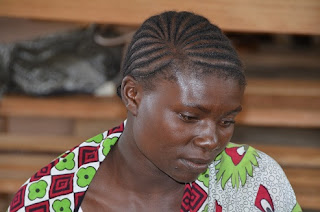

Leonetin Myungile, 30, has six children.  She wants to start a SACCOS so that she can invest in her shamba.  Her goal is to send all of her children to secondary school.


Roniko Kilave, 38, wants to start a SACCOS so that he can apply the new farming methods that he has learned to his fields.  He also wants to buy some chickens so he can sell eggs.  He has 5 children.  He could not go to secondary school so he would like to be able to send all of his children there.


As we were leaving the meeting Enock spied this woman carrying bananas.  She was on her way to her kiosk to sell her bananas.  Bananas here sell for 100 Tsch each ($0.07), in town they sell for  300 Tsch each.  Enock bought them all for 300 each.  "When I go to the villages I like to help the local people by buying what I can from them," he told me.


It was still raining when we walked back to the car.


On the way back we stopped at Kidabaga to pick up the pastor.  He had ridden the church's motorcycle this far and rode the rest of the way to Iringa with us.


Sandy was trying to relax as we stopped for the pastor.

Tuesday, March 6, 2012

Mgama – The Word Spreads


This morning we picked Enock up at Tumaini, Itiweni at her stop and headed for Mgama – an hour’s drive south west of Iringa, near Ihemi.  Mgama lies a short drive off of the main road.  It is in the same district as Ihemi (our partner congregation).  The district pastor who lives at Ihemi also covers Mgama.  As a result the pastor here often goes to Ihemi for meetings.

Pastor Edward Mgeyekwa has been at Mgawa for three years.  He has 11 preaching points and 880 adult members in his congregation.  He invited us to come and meet with 30 people who want to start a SACCOS.  “I have been to Ihemi many times and have seen how it is helping the people there.  Since Ihemi got a SACCOS their members have benefited greatly.  We really need to have a SACCOS here to help us,” he told us.

We went to see their CVP crops.  This is the first year for this demonstration plot so they did not have any results yet.  Along the way Tom found some kids – of course this meant he had to go get candy – and of course this meant that more kids showed up in the corn!  It’s amazing how he keeps finding these kids; or is it the kids who are finding him?

When we got back from the CVP we started the meeting.  Even though the pastor had only 30 on his list of interested people, 35 showed up for the meeting!  We each gave our opening greetings and talks, then Enock took over and gave Itiweni the day off from teaching (she was not feeling well today so she was glad to have the day off).  He discussed how to start a SACCOS, the importance of savings, how to organize, etc.  

When Enock’s class was over the class attendees held their own meeting to elect officers.  These elected officials will attend the training session in two weeks where they will receive further instructions in organizing and running a SACCOS, and help in writing their constitution. We ate lunch while they elected a chairman, secretary, and treasurer; two men and a women – the woman is the treasurer!

Since Pastor Mgeyekwa had given us a male perspective on why the community would benefit from a SACCOS, we invited the women to provide a spokesperson to give us a female point of view.   Thirty-year-old Tamasha Mkakatu was asked “Why are you interested in forming a SACCOS in Mgama.”  Her response: “Life is very difficult here in Mgama.  We don’t have enough capital to plant our fields.  Those who would like to have a small shop cannot get any capital to start with.  We would like to keep animals, but we don’t have the money to buy them and can’t get loans.  Most of our people cannot afford to send their children to secondary school.  I know that a SACCOS would change this!”

We left Mgama promising that we would have a constitution for their leaders to look at when they attend our training session. 

We returned to Iringa earlier than many days, but we had things to do before we could call it a day.  After dropping Enock at Tumaini, we accompanied Itiweni to Kihesa where we met with Pastor Kiwanga to make arrangements for the training session.  Last year the 4 day session was held here, with meals and lodging provided for all of the attendees.  At that time the Kihesa center could house everyone, but this year the anticipated number of 60 far exceeds the number of beds at Kihesa.  

The overflow will have to be housed in local guest lodges.

Following our meeting at Kihesa, Tom had errands to do in town and Sandy made a return trip to the Radio Furaha station to record more jingles.  We’re not sure if that’s because the first ones were really good or really bad.

It was good to get back home tonight.  I’m afraid that we are a bit worn out and tomorrow we plan on going to Kivalamo – a three hour drive with some difficult roads.  We await the traffic report.  Here the traffic report is not about rush hour, white-outs, or ice and snow.  The report will be a phone call telling us whether or not torrential rains have made the roads impassable.  Today’s weather report:  a low pressure system in the Indian Ocean is expected to bring in heavy rains from the Congo.  Stay tuned……


Mgama is a short drive off of the main road.


Pastor Mgeyekwa told us, "I have been to Ihemi many times and have seen how it is helping the people there.  Since Ihemi got a SACCOS their members have benefited greatly.  We really need to have a SACCOS here to help us,”


On the way to the CVP field Tom found a child who needed some candy.


This is the first year for this plot.


It’s amazing how Tom keeps finding these kids; or is it the kids who are finding him?


Sandy always hands out pens.  It's amazing - everyone seems to be genuinely pleased to get one!


Itiweni got the day off as Enock gave the seminar.


35 people showed up even though only 30 had signed up!


This little girl was too shy for candy.


Tamasha Mkakatu told us,"Life is very difficult here in Mgama.  We don’t have enough capital to plant our fields.  Those who would like to have a small shop cannot get any capital to start with.  We would like to keep animals, but we don’t have the money to buy them and can’t get loans.  Most of our people cannot afford to send their children to secondary school.  I know that a SACCOS would change this!”

Monday, March 5, 2012

A Day At Mwatasi


Yesterday, Sunday, we crashed!  I’m afraid that we were so worn out that we spent the entire day inside doing a little reading, a little looking on the web, and lots of sleeping!  Today however we were back on the road with a trip to Mwatasi!

Mwatasi is a two hour drive south east of Iringa.  To get there you take the road to Pommern and instead of turning off, head out towards the hills.  Since it was a bit longer we could not drive straight through but had to stop and let Tom walk around a little (he needs to get out and walk around every hour or so to prevent embolisms from forming).  Stopping on the side of a hill we got a good look at the landscape – beautiful up here!  While we were looking around Tom spied a kid – so out came the candy.  Sure enough, once one kid had gotten candy more started coming out of the corn field.  Mama was watching – but she only laughed when she saw what they were getting. 

When we got to Mwatasi we were greeted by Pastor Elias Kadnda.  This is his first congregation since graduating from Tumaini 2 years ago.  Itiweni knows him from the University, it turns out he knows many of the students that were in Sandy’s communications classes at Tumaini in 2005.

Mwatasi does not yet have a SACCOS.  There is a group that has been meeting to form one.  After tea we met with the group.  This group currently has 36 members, 28 of whom attended the meeting.  After greetings and some discussion about who we are and how we can help them, Itiweni gave her presentation entitled “Uanzishwaji wg SACCOS” (starting up a SACCOS).  Tom is recording her instructional presentations and will be putting them on DVDs.  We brought some portable DVD players, hoping that in the future they can be used in villages where SACCOS are being formed.

Itiweni’s talk today covered the basics of getting organized, selecting the first officers, etc.  She emphasized the need to generate savings FIRST and then do business plans and work on loans later.  Three leaders (chairman, treasurer, and secretary) will be elected to start collecting savings.  Itiweni will be back later on to continue her instructions on running a SACCOS.

After the meeting we went over to look at the CVP acreage.  The corn was looking very good.  The pastor told us that up here there seemed to be too much rain to use the hybrid corn that was being used elsewhere.  He explained that when they planted half the plot with their traditional seed and half with hybrid seed the traditional seed did better (Mwatasi gets a lot of rain and is higher in the mountains than the other sites we have visited so far.).  He went on to say that when they combined their older seed with the spacing and other techniques from the CVP plot they were able to increase their yields 2-3 times.  Unfortuantly they cannot afford to use the CVP techniques without a loan for their crops – which is why they have started working on getting a SACCOS!

Two women were hoeing in the field right next to the CVP corn.  The pastor told us that the church members were all asked to come and hoe this field up so they could plant beans. Of the 1250 members, only these two women showed.   They had been working since early morning and it was now 1:00. 

When we went back to the church there were some members waiting to talk to us.  One of them happened to be the village mayor and the councilman from the Bomalang’ombe Ward on the Kilolo District Council.  Mayor Michaal Kisava, 50, told us that he wanted to get a SACCOS started as soon as he could.  He said that he believes that a SACCOS is necessary to help “this poor district of mine” develop (His ward, includes 5 villages including Bombe la ngombe and Mwatasi.).  The first thing he looks for is to have the people learn to save and budget their money.  “The education through your program is a real must for us to move forward.”  After that he says they need loans to develop their shambas.  “Right now we can only apply the CVP methods to a small part of our farms.  With a small loan we could do much better.”

Alafrisa Mpogole, 43, told us much the same thing.  “The first thing that we need is to learn to plan and budget and save,” she told us.  “A SACCOS will help bring changes to the village through learning.”  She is planning on telling others to join and hopes that Itiweni can come back soon to give them more lessons on savings.  She said that she has 6 children that she and her husband support.  One of them is a vocational school graduate who is now married, 2 of them are in secondary school, and 3 are still in primary school.  “We want to send them all to school – but there is not enough money for this.  We need a loan so that we can improve our farming and send them all to school.” 

As we were getting ready to go the children attacked!  (Actually the children are always very polite.  They come over and stand and smile and giggle a little to get attention.  They wanted Tom to give them candy of course!)  Tom had been giving some candy to the children as he saw them, but now they had banded together and were hoping for more!  Tom took a few photos of them and then a short video. He started the video playing on his camera and showed it to them.  Giggles, giggles, and more giggles went through the crowd.  We gave them a bit of candy and then we were off for Iringa.  


On the way to Mwtasi these carts were the biggest traffic concern.


Tom had to stop and get out.  Soon he had kids coming out of the corn field for - you guessed it - candy!


The views are really beautiful up here.


The class was very well attended.


This little stinker kept sneaking up the aisle for more!


The Mayor had lots of questions.  He also could not help giving the attendees a speech!


When Sandy quipped that it might be planting season, but to quote Jesus, “the harvest is plentiful but the laborers are few,” Pastor Kadnda translated it into Swahili for the group.  Their laughter let us know that they were familiar with the quote as well. 


Mayor Michaal Kisava, 50, told us that he wanted to get a SACCOS started as soon as he could.


Alafrisa Mpogole, 43, told us much the same thing.  “The first thing that we need is to learn to plan and budget and save,” she told us.


Sandy thwarted the kid's attack by handing out more candy!

Saturday, March 3, 2012

Mkwawa – “We Take Our SACCOS Seriously”


This morning we took a short, ten minute drive to Mkwawa.  Mkwawa lies on the other side of Iringa, just past the Danish book store and down a dirt road.  The church is an attractive brick building that is undergoing some upgrades.  Next to it sits a huge new church that they are building.  “The old church will hold a bit over two hundred while the new church will easily hold a thousand” said Upendo Koko, pastor.  It has been under construction for 8 years now.  The church has 1050 adult members spread over the main church plus 3 preaching points.

The Mkwawa SACCOS was started in 2006 by the members of the church.  Over the years it has been funded by their savings, share prices, and the interest on loans.  Currently the SACCOS has $2,500 in capital provided by its 29 members (17 women and 12 men).  Being less rural than most other SACCOS the members are more “business people” than farmers.  (The definition of business people includes many members who are raising livestock by their homes.)

We met with the pastor and discussed our visit first and then went over to meet with some of the SACCOS members.  On the way we saw hundreds of kids.  “This is the Saturday class for children in need.  These children are living with grandparents, distant relatives, etc.  They come here on Saturday for singing, classes, play time, and lunch.”  Tom wanted to hand out candy but with so many children he just did not know how to start!

Ten of the members had shown up for our visit.  The pastor explained that the rest were working today (We came on a Saturday because this church being urban would most likely have many members who could not leave work during the week.).  We greeted them, introduced ourselves and explained the reason for our visit.  Then Itiweni gave her class on the rights and responsibilities of SACCOS members.  Following her presentation the members raised several questions that were answered by Itiweni.  One member wanted to know if anyone could call for an audit (the answer is yes, if enough members agree).  Another one wanted to know if they can take people’s collateral if necessary (again the answer is yes).  A third wanted to know if it was alright to join a SACCOS only to save money (certainly!).  Tom closed with a prayer and we met with the leaders.

Despite having started in 2006 this SACCOS does not have a constitution.  It seems that they have been following the correct procedures for years – still they really wanted to make sure they were doing what they should be doing (We will give them a copy of a constitution to vote on during our upcoming training session.).  We sat and discussed their experience with them. They have had 100% repayment on loans for several years now.  We were told that at one time there were members who didn’t pay and the SACCOS took their savings, their collateral, and made their guarantors pay any outstanding loans.  This has happened in less than 1 or 2% of their loans, but they have always gotten paid.  They also revoke membership of anyone who does not pay.  This is a very big incentive for people to be prompt.  Right now there are 2 members who are taking extra time to pay – but they will pay more interest to do this.  We were impressed that they took these actions.  They were surprised that anyone would consider doing anything else! 

We talked awhile about their need for capital.  Currently they have ten members who want to join – but they will not let them join until they have more capital or unless they agree to use their SACCOS only to save money.  “We really need another 12,000,000 Tsch (about $8,000) to be able to cover the needs of our existing members plus these new ones.  We would like to get some help from our partner parish – but we are reluctant to ask them.  They have been so good to us already.”

We told them that it was their decision and complemented them on their excellent management of their SACCOS.  They have joined the Iringa Hope Joint SACCOS.  Their Treasurer has been chosen as an officer.  They were clearly very proud of this.

As we broke up we went to talk to some members.  One member, Peti Sovelo, 50, has 6 children and has been a member of this SACCOS for some time now.  He told us he has been a member for a number of years and has benefited greatly.  This past year has been difficult for him.  He took out a loan for $265 to plant vegetables and raise pigs at his home.  The vegetables did very poorly due to a drought – still he salvaged what he could and paid back $200 so far.  The remaining $65 (plus interest) he will pay over the next two months as he sells some of the pigs.  “It was difficult when the vegetables did poorly, but I never considered not making my payments.  I had promised to do this and I have.”

We also talked to Tula Mnyawami, 76, a widow with 6 grown children.  She has 3 of her grandchildren living with her.  Last year she took out a loan for $70.  She took this money, together with some she had saved, and bought 100 chickens so that she could sell eggs.  After the chickens grew up and started laying eggs she was able to get $14/week ($7 profit) from the eggs they laid.  Things were looking pretty good until thieves broke into her house while she was at a funeral and stole the chickens.  “I will finish paying back my loan next month” she proudly told us.  “I never considered not paying it in full – I owed it and I will pay it.”  She hopes that after she finishes paying her loan back she can get another one and try raising chickens again!

We gave Tula a ride back to her house and she gave us a tour.  Her home is spacious and in the living room she has pictures on display.   Tula started teaching in 1956 and retired in the 1990’s.  Her husband was the first General Secretary of the Iringa Diocese.  We chatted in English and were impressed by the English language skills of this elderly woman.  We looked over the area where her chickens had been living before thieves stole a good share of her livelihood.

We were very impressed by the people at Mkwawa – hard working, honest, and very proud of what they are accomplishing!  Asante sana Mkwawa!


The existing church was having some brick work done.


There were hundreds of children there for classes.  Tom did not know how to start handing out candy - so he didn't!


Ten of the members showed up for the class.


Peti Sovelo, 50, has 6 children and has been a member of this SACCOS for some time now.


We also talked to Tula Mnyawami, 76, a widow with 6 grown children.


We took her to her house.  She has 3 of her grandchildren living with her.


She had 100 chickens in this area laying eggs when thieves scaled the wall and stole them while she was at a funeral.  I looked around and counted three left.


Sandy and Tula looked at some old pictures from when she was a teacher.
  

Friday, March 2, 2012

A Day At Nduli


If you drive north out of Iringa on the Dodoma road you will pass the airport and, after about 20 minutes, find the turn-off for Nduli.  A ten minute drive down this road gets you to Nduli.  The church at Nduli is a pretty brick structure that, according to a cornerstone, was built in 2002.  Pastor Laiton Muyinga came out of the parsonage to greet us.  His was a familiar face, as we recognized him as a member of a district choir we heard at Tumaini in 2001.  Don’t give us credit for remembering a face we saw only once 10 years ago; Tom recorded the concert and we have watched the video many times. 

Induli is a relatively large congregation with 8 preaching points and about 1,000 active members (about the size of most Lutheran churches in the US!).  The pastor at Nduli has big plans for his parish.  He has started a number of new enterprises from harvesting honey to making peanut butter.  To get these plans going, and to give the farmers here the capital they need to do a good job in their fields he wants to see a SACCOS started.  “I think that a SACCOS is a must for my parish,” he told us.  He believes that unless he can get a SACCOS started there will not be enough capital for the parish to operate.

After tea with the pastor we went to their World Day of Prayer service.  It lasted about 2 ½ hours.  In attendance were 26 women and 13 men.  The church service was designated especially for women.  In the middle of the service the women performed a play based on a parable of Jesus in Luke 18:1-8. It was amazing!  The play was teaching them about the very problem that started us working with micro finance!  The problem is that traditionally when a man dies his eldest male relative inherits everything – his property, his money, his family – and comes and takes what he wants and leaves the rest.  Since he often only wants the property and not the family this results in many widows being left destitute.  In the play the woman goes to a judge and the judge reluctantly grants her the right to all of the property and tells her she does not have to go with her deceased husband’s elder brother.  (This is of course the law, but most people do not know this and often ignore it.)  As in the scripture lesson, the widow had to be persistent, and plead her case before the judge many times. The women were great!  Even without knowing Swahili, we could follow the story fairly well.

Following the service we met with the emerging SACCOS.  So far this group has organized enough to elect a chair, treasurer, and secretary.  68 people have joined this group, each paying 20,000 schillings to join.  This means that they now have 1,360,000 schillings (or about $905).  They wanted to open a bank account and deposit money but they could not do this without a constitution.

We spent about two hours with them explaining the basics of how a SACCOS works and what would be in a constitution.  We told them we would send them a constitution to read and vote on.  We also invited their leaders to come to the training session in two weeks and told them we would give them the forms they needed and show them how to keep their records. 

Tom spent some time telling them how a good SACCOS is a partnership between strong Mamas and strong Babas.  Since they have already chosen 2 men and one woman as leaders we suggested that they elect a woman as a vice chair and try to keep their board and committees balanced.  (Of the 68 members, 48 are women and 22 are men.)  We also discussed the need to grow their SACCOS with savings.  With the strong leadership of their pastor and the good mix of members we think this will be a good SACCOS.

As the meeting broke up we talked with some of the members about why they wanted a SACCOS.  Larensia Malila, 44, told us that she wants to start a business and needs to get some capital (she is hoping to get $200 to go into business).  “I need to have a kiosk to pay for my children’s school fees.” She told us.  Her husband works at the airport and has uncertain hours and income.  She has 5 children, three of which are going to secondary school partly due to scholarships.

Festo Mtega, 34, has 3 children and wants to improve his farming and maybe start a business.  “I have learned how to improve my farming from the CVP plot but I can’t apply this unless I can get some capital.”  He also would like to implement some of the ideas that the pastor has brought to Nduli – but he can’t without raising some capital (he is hoping to borrow $250).  Festo wants to be able to pay his children’s school fees, build a new house, and buy dairy cows.

As we were leaving some kids came around looking for the candy-man. Sandy took over the responsibility of giving these children their sugar-fix, making a few new friends with big smiles.
Tomorrow we are off to Mkwawa.


Nduli is an attractive church just a short way from the Dodoma road.


The parsonage looks nice but the walls are crumbling.  They are building a new one with guest rooms!


We thought the pastor looked familiar.  We had seen him in a choir concert in 2001.


The worshipers were mainly women.  It was a special service dedicated to Mamas.


These two kept peeking at Tom.  They wanted more candy!


As soon as church was over they got some!


The SACCOS meeting was crowded.


Larensia Malila wants to borrow some money to buy a kiosk.  She hopes to be able to pay for her children's school fees.


Festo Mtega would like to be able to implement what he has learned from the CVP plot.  Without a loan there is not much he can do.


Sandy took over for the candy man (I think she was jealous).


Thursday, March 1, 2012

A New Start At Itungi


This morning we took a drive down the road towards Dar Es Salaam.  When we got to the other side of Ilula we turned right onto a dirt road and drove to the top of a hill.  This is where Itungi is.  It is a very pretty setting with a relatively new church.  The pastor greeted us and (surprise) asked us in for tea!

We were here today to talk about the group trying to start a SACCOS.  Apparently they have been meeting and talking about this for the past four years.  The group started out fairly large (maybe 100 at one time) but has shrunk down to about 30 now.  Itiweni was here last fall doing some training.  She gave two classes to the leaders and gave them some work to do.  They were to meet with her with the needed information and forms in November (they did not come), then December (they did not come), then January.  Our meeting today was to discover the reason why and to chart a course for the future.

We visited with the pastor for awhile about the difficulties the community is having in getting a SACCOS started.   When we finished our tea and our discussion with the pastor there were several villagers waiting to talk to us; a group consisting of 9 women and 7 men.  There is a CVP (Companion Village Plot) at Itungi and the villagers need more capital to follow the CVP farming methods.  Several of them comment that they do not have enough capital to plant and no one will lend them money.  One woman told me that she can get a loan in town for 1 or 2 months at 5% - but she needs to have 6 months for her crop, a comment we have heard before.

As we talked to the group their problems became clearer.  They started meeting four years ago after they found an old constitution.  They had heard that this was a way to get capital for their farms and desperately wanted to have a SACCOS.  Unfortunately they did not understand the way a SACCOS works and the constitution that they had contained many errors.

They elected officers, collected entrance fees and share prices (about $13 each) and waited for their leaders to get things working.  The leaders collected these funds but did not understand what to do next.  After almost 3 years we learned of their difficulties and Itiweni went to teach them what they needed to know.  By this time, however, the leaders were discouraged and did not pay attention.  As a result they never followed through on any of the things that Itiweni asked them to do.

We recognized that this group needs new leaders.  We encouraged them to elect a combination of women and men to leadership positions.  We have noticed time and again that when women have a significant presence in the leadership of a SACCOS things get done and the SACCOS works!  (Sorry guys – but that is the way it is here.  Probably the women are more interested in how the family is supported – just a guess because I really don’t know!)

We discussed the importance of savings, working together in the SACCOS, how loans work, etc.  We made arrangements to visit them on Sunday the 11th of March when we will bring along a new constitution for their approval.  We plan to give them instructions on understanding the constitution and the election of officers.  We will also make arrangements for the new leaders to attend the training sessions this month! 

Everyone seemed excited – but we will see when we come back on the 11th.  We told them to listen to Itiweni and Tom on radio Furaha on Thursday when they talk about “Giving and Saving.”  (We are giving a series of talks on the benefits of SACCOS, savings, giving, and what it means to work in a coop.)

After the meeting we went to see the CVP plot.  It’s a long drive through the brush – but we made it!  Sandy ventured across the muddy field, but Itiweni stayed in the car.  Her comment:  “I have been to so many CVP plots already and my shoes aren’t good for this.”

Back in Iringa we had a meeting with the regional cooperative officer with the purpose of working together on SACCOS issues.  Oh well, it is not 6:30 yet!


Itungi is a 20 minute drive from Ilula.  (It is a very pretty dive up the hill.)


The church where we met is fairly new.


A group of Mamas were waiting for us to talk to them.


This Mama commented that she needed capital to use the CVP methods and no one would lend her money.


Afterwards we went to see the CVP plot.  It was a bit of a drive through the brush.


Sandy struggled through the mud but Itiweni thought she could see fine from the car!


The view from up here is really pretty.


Back in town Itiweni and Tom met with the new coop officer.


The end of the day brought a visit to the market.  We will get home before 6:30 today!!